
Aperture describes the size of the opening in a camera’s lens. The amount of light let into the camera is measured in f-stops. Think of aperture like you would the pupil of your eye. It controls light. The higher the f-stop number, the smaller the opening and the less light the lens allows in. Zoom lenses tend to have a range of focal lengths while prime lenses have one maximum focal length. All of the images above were taken with an 85mm lens at various f-stops. The higher the f-stop, the longer the lens stayed open to capture the image. To achieve a sharp image at f/22, I had to use a tripod. The lens stayed open for 1.3 seconds.
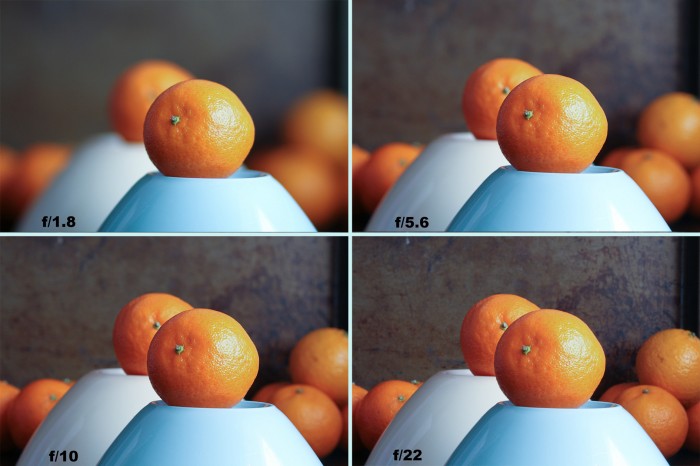 Depth of field is the area of the image that appears sharp and the size of the aperture has an impact on this. In the image above, f/22 is a higher f-stop (smaller aperture) and the foreground and background are in focus. The smaller f-stop, f/1.8 isolates the background and foreground. Notice the orange in front is in focus and the rest of the image has that buttery blurry background. This is also an example of shallow depth of field. Just keep in mind, the larger the aperture, the smaller the area of focus. Want to learn more? Check out these articles: What is ISO? What is Shutter Speed? Photo Composition: The Rule of Thirds
Get my eBook, Ten Awesome Photography Projects and get started shooting today!


[…] Understanding Aperture and Depth of Field […]
[…] Understanding Aperture and Depth of Field […]
[…] Understanding Aperture and Depth of Field […]
[…] Understanding Aperture and Depth of Field […]
[…] Understanding Aperture and Depth of Field […]
[…] Understanding Aperture and Depth of Field […]